

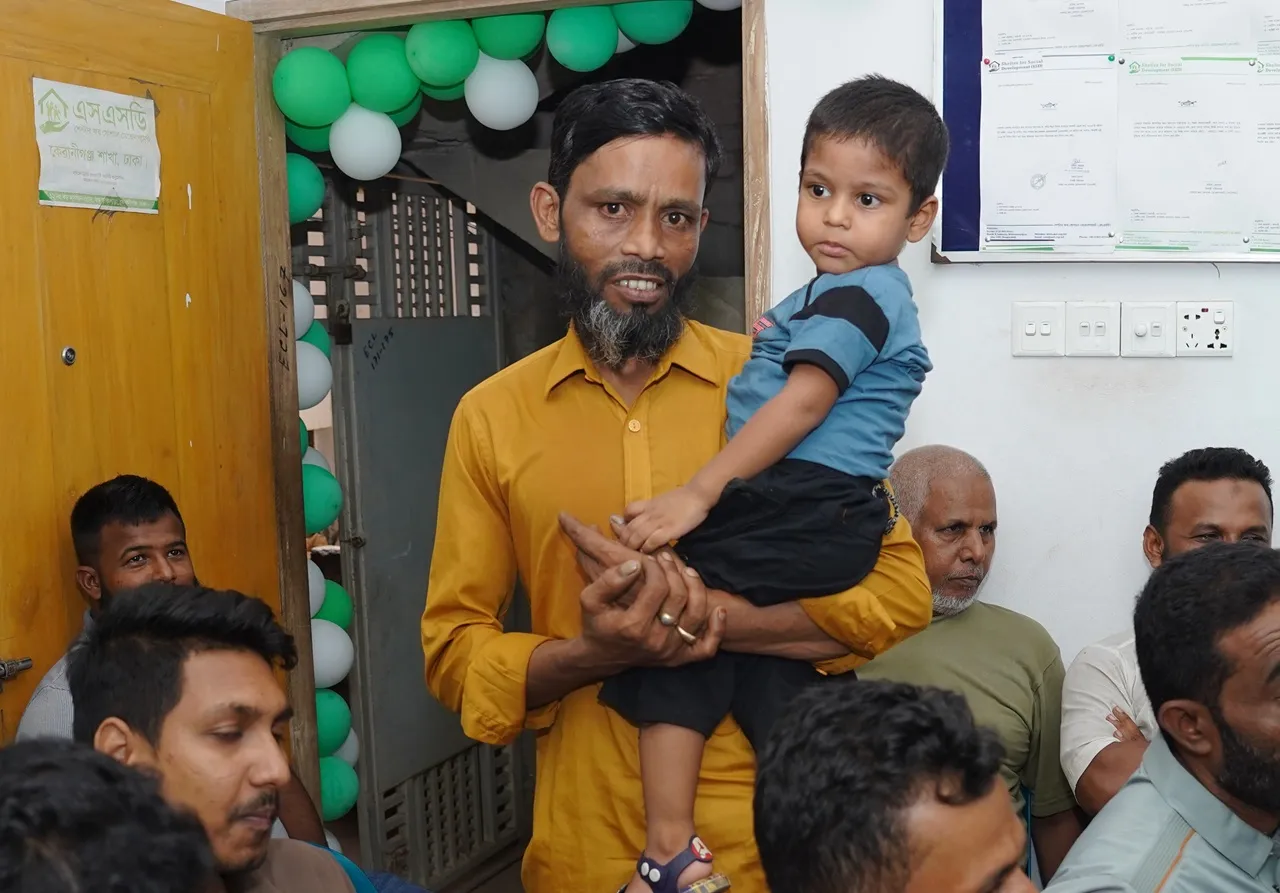
Rongu left his home in Tara'il, Kishoreganj. He came to Keraniganj, Dhaka with his family. He had a simple trade. He bought and sold scrap iron. He had no shop. He had no fixed income. He had no clear path forward. Then he got support from SSD's microfinance program. Step by step, he built a permanent shop. His business grew. Today he employs five people. This is his story.
When Rongu packed up and left Tara'il in Kishoreganj, he was not running from something. He was moving toward something — a chance to build a better life for his family. He chose Keraniganj, Dhaka. He had no shop, no established trade, and no guarantee that things would work out. What he had was a willingness to work and a determination not to go back empty-handed.
Starting From the Streets
In Dhaka, Rongu found his way into the scrap iron trade — buying and selling old iron goods, moving from place to place, building small relationships with buyers and sellers in the area. It was honest, physical work. Some days were good. Many were uncertain.
The biggest obstacle was simple: he had no permanent shop. Without a fixed location, it was difficult to grow. Customers could not find him consistently. He could not stock goods in volume. Every day felt like starting over.
He knew what he needed to do. He just needed the means to do it.
A Loan That Changed the Direction
Rongu approached SSD and took out a loan through its microfinance program. He did not use it to take a shortcut. He used it carefully and deliberately — reinvesting, expanding his stock, strengthening his trade relationships, and slowly building the foundation of something more stable.
It was not an overnight transformation. It took time, discipline, and consistent effort. But that is exactly the point. The loan gave him the push he needed. The work he put in after that was entirely his own.
A Permanent Shop in Kadamtali
Eventually, Rongu established a permanent shop in Kadamtali, Keraniganj. For someone who once had no fixed address for his business, this was not a small thing. It was the moment the trade became a real business.
With a permanent location, everything changed. He could maintain steady inventory. Regular customers knew where to find him. His reputation in the local trade grew. And his income, for the first time, became something he could plan around.
Today, Rongu employs five people in his scrap iron business. Five men who come to work every morning because Rongu built something large enough to need them.
The Ripple Goes Further
Rongu's story does not end with him. His wife, while managing the household, has used the stability his income brought to pursue something of her own. She is learning tailoring — building a skill that will give her financial independence alongside her role in the family.
And then there are the five employees. Each of them has a family. Each of those families depends, in part, on the business that Rongu built. SSD's role in Rongu's journey did not just change one household — it set off a quiet chain of support that reaches further than any single loan amount could suggest.
From Tara'il to Kadamtali — A Journey Worth Telling
Rongu came to Dhaka as a migrant with a modest trade and no shop. He leaves this story as a business owner, an employer, and the head of a household that is moving forward with confidence.
He often says that SSD was the turning point. Not because SSD did the work for him — but because the loan gave him the foundation to do the work himself. That distinction matters. SSD does not create success stories. It creates the conditions in which people like Rongu can write their own.
One Family. Five Employees. Many More Like Them.
SSD works with people across communities in Bangladesh who have the drive to build something — but lack access to the financial support that would let them begin. Rongu is one of them. There are many others.
Through its microfinance program, SSD continues to stand alongside individuals and families who are willing to work, willing to grow, and willing to build — one step at a time.
Rongu is a beneficiary of SSD's microfinance program, currently operating his business in Kadamtali, Keraniganj, Dhaka. His story is shared as part of SSD's ongoing effort to document and celebrate the real-world impact of financial inclusion in underserved communities.